Installing a Level 2 EV charger in Northern New Jersey? Learn how to determine the right breaker size, why professional load calculations matter, and how Vaccarella Electrical Services ensures your home is ready for the future.
What Size Breaker Do You Need for a Level 2 EV Charger?
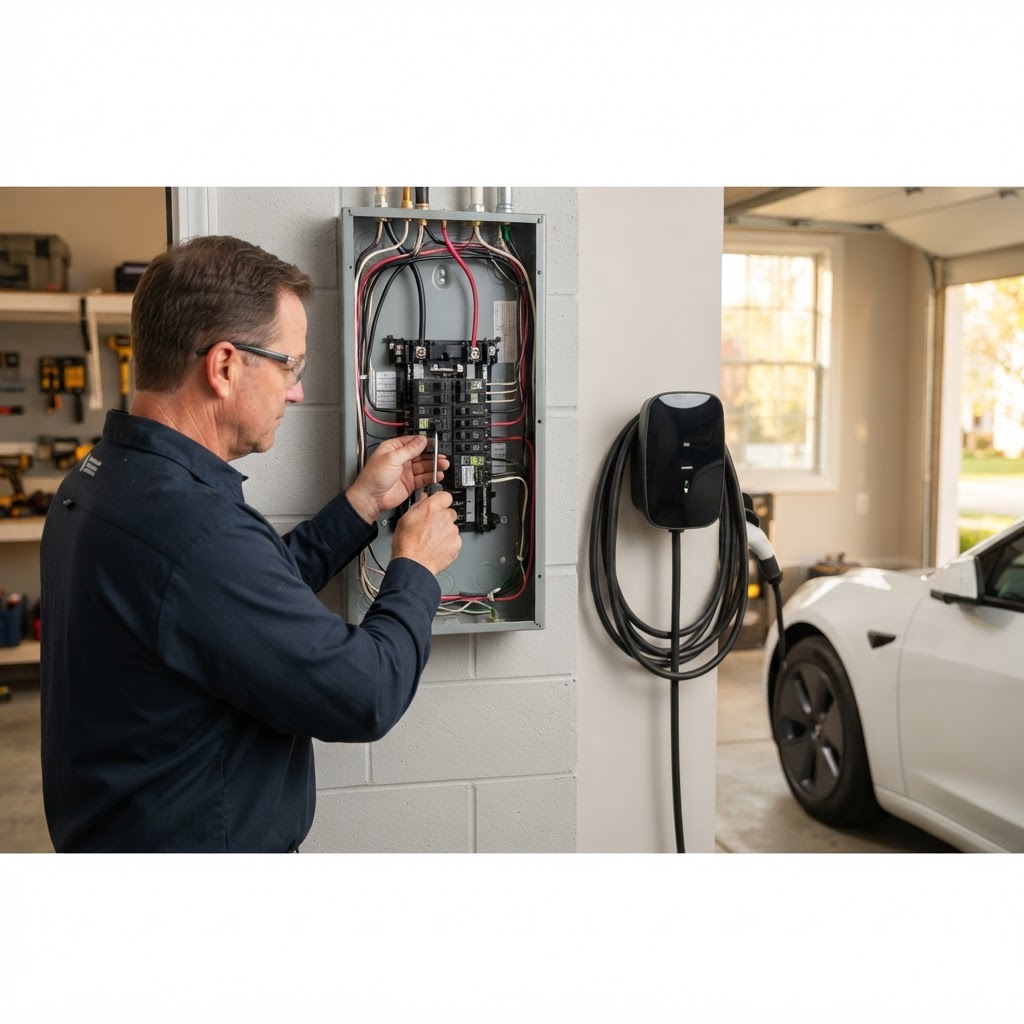
In most residential installations, a Level 2 EV charger typically requires a 40-amp or 50-amp double-pole breaker. However, the exact size depends on the amperage of the charger itself and the specific requirements of the National Electrical Code (NEC). Because the NEC defines an EV charger as a continuous load, the circuit breaker must be sized at 125% of the charger's maximum current draw.
Understanding Circuit Requirements for Northern New Jersey Homes
As electric vehicle adoption accelerates across Bergen County—from the historic homes in Ridgewood to the modern developments in Paramus and Mahwah—homeowners are increasingly realizing that their existing electrical systems may need an upgrade. Simply installing a charger on an existing circuit is rarely an option; the safety of your home depends on a dedicated circuit designed to handle the specific power demands of your vehicle.
Why Load Calculations Matter
Before installing any high-voltage appliance, a licensed electrician must perform a load calculation. Northern New Jersey features a diverse range of housing stock. Older homes in towns like Englewood or Teaneck may have 100-amp service panels that are already near capacity due to central air conditioning, electric dryers, and modern kitchen appliances. Adding a 50-amp EV charger to an overloaded panel creates a significant safety risk. At Vaccarella Electrical Services, we assess your main panel capacity to determine if you can support a new load or if an electrical service upgrade is necessary.
The Role of Local Permits and Inspections
Whether you reside in Fairlawn, Franklin Lakes, or Hackensack, all EV charger installations require a permit and subsequent electrical inspection. These local authorities ensure that your installation meets the NEC and any local amendments. Attempting a DIY installation is not recommended, as improperly sized breakers or loose connections can lead to overheating and fire hazards.
Planning Your EV Charger Installation
When preparing for your installation, consider the following:
- Charger Output: Check the manufacturer's documentation. A 32-amp charger requires a 40-amp breaker, while a 40-amp charger requires a 50-amp breaker.
- Panel Space: Ensure you have physical space in your panel for a 2-pole breaker.
- Distance: The distance from your panel to the charger location impacts voltage drop and conduit requirements.
Professional Installation with Vaccarella Electrical Services
At Vaccarella Electrical Services (NJ Electrical Contractor #16628), we specialize in residential EV charger installations across Northern New Jersey. We are bonded, insured, and dedicated to safety. If your panel isn't ready, we provide expert electrical service upgrades to ensure your home can support your new EV and all your other modern power needs. Contact us today to request a free quote via our website contact form or call us at (201) 966-0019 to discuss your project.
Frequently Asked Questions
- Do I need a 240-volt outlet? Yes, Level 2 charging requires a 240-volt dedicated circuit.
- Can I charge at 20 amps? Yes, if your charger and vehicle support it, a 20-amp breaker may suffice, but 40-50 amps is standard for faster charging.
- Does an EV charger increase my electric bill? Yes, you will see an increase based on your mileage and local utility rates.
- Can you install chargers in older homes? Yes, but a panel upgrade to 200 amps is often recommended.
- Is a permit required in Bergen County? Yes, every municipality requires a permit and inspection for EV installations.
- How long does installation take? Most standard residential installations are completed within one day.
- What is a dedicated circuit? It is a circuit that powers only the EV charger, preventing other appliances from tripping the breaker.
Glossary
- Double-Pole Breaker: A breaker that connects to both sides of the electrical service, providing 240 volts.
- Continuous Load: A load where the maximum current is expected to continue for three hours or more.
- Amperage (Amps): The unit of measurement for the flow of electrical current.
- Voltage: The electrical potential difference.
- Service Panel: The main distribution board where your home's circuits originate.
- Load Calculation: A calculation to determine the total electrical demand on a panel.
- NEC: The National Electrical Code, the benchmark for safe electrical design.
- Hardwired: A charger connected directly to the electrical supply without a plug.