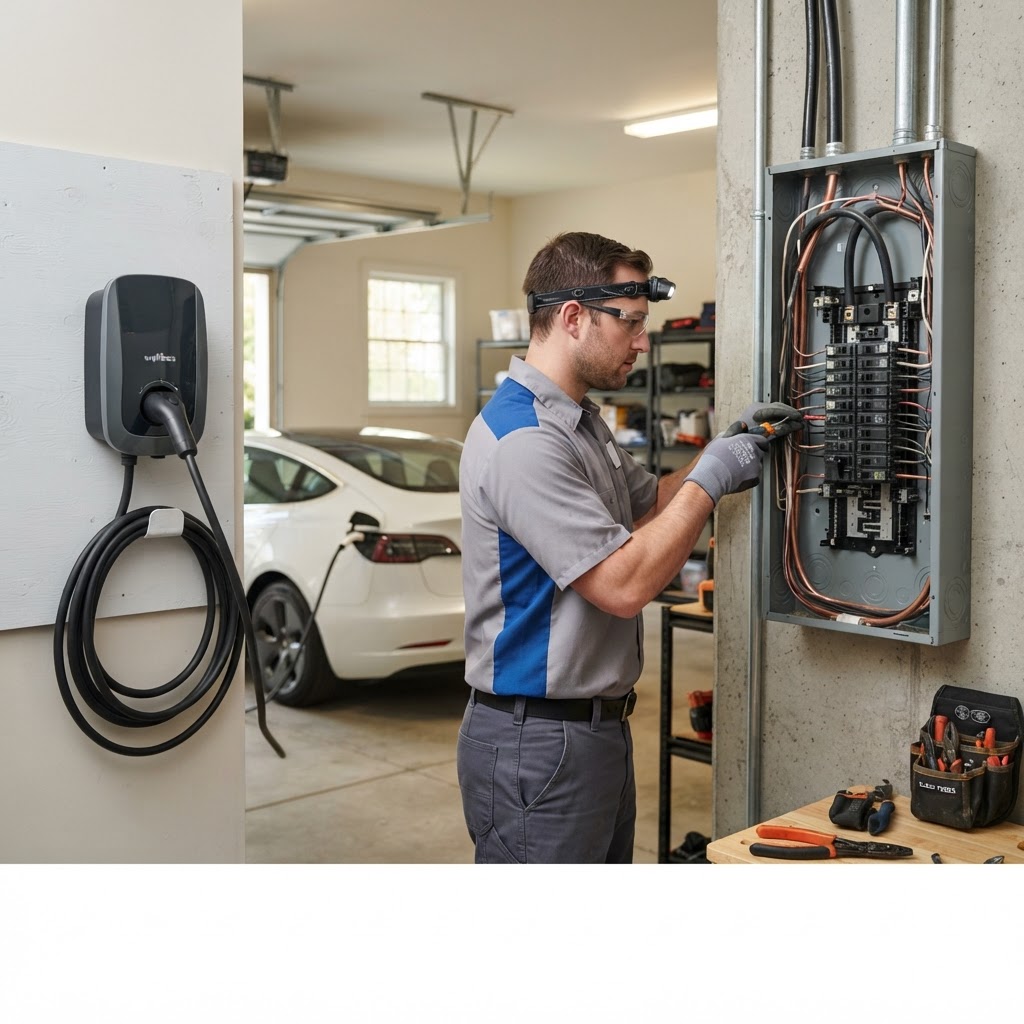
Wondering if your home's electrical panel is ready for an EV charger? Learn the signs that you might need an upgrade and how Vaccarella Electrical Services can help.
Can Your Electrical Panel Handle a Level 2 EV Charger?
The short answer is: it depends on your current electrical service capacity and existing household load. For most Bergen County homeowners, adding a Level 2 EV charger requires a professional load calculation to ensure your system can safely handle the additional demand without causing breakers to trip or creating potential fire hazards.
Understanding Electrical Load in Northern New Jersey Homes
Many homes in towns like Ridgewood, Paramus, and Franklin Lakes were built decades ago when energy needs were far lower. If your home still relies on a 100-amp service panel, adding a heavy-duty appliance like a Level 2 EV charger—which can draw between 30 and 50 amps—may push your system beyond its limits. Modern households often juggle smart appliances, central air conditioning, and finished basements, leaving little "breathing room" for an EV charger.
Signs You Need an Electrical Service Upgrade
Before installing a charger, our team at Vaccarella Electrical Services (NJ Electrical Contractor #16628) evaluates your panel for common warning signs, including:
- Flickering lights when appliances turn on.
- Breakers that trip frequently during normal use.
- Visible signs of heat or charring inside the panel.
- A panel that is completely full with no space for a dedicated 240-volt circuit.
The Importance of a Dedicated Circuit
Level 2 chargers require a dedicated circuit. This means the circuit breaker is reserved exclusively for the charger, preventing it from sharing power with other home systems. In older Northern New Jersey homes, finding space in the panel for a new double-pole breaker can be a challenge, often necessitating a service upgrade to 200 amps to accommodate the extra load safely and in compliance with the National Electrical Code (NEC).
Local Permitting and Safety in Bergen County
Installation requirements vary by municipality—from Hackensack to Mahwah and Englewood. Local building departments require permits to ensure that electrical work meets current safety standards. As a licensed, bonded, and insured contractor, Vaccarella Electrical Services handles the technical requirements, load calculations, and permit processing to ensure your installation is up to code.
Expert Installation with Vaccarella Electrical Services
Don't guess with your electrical safety. Whether you are in Teaneck, Fair Lawn, or anywhere in Northern New Jersey, we provide professional assessments to determine if your panel needs an upgrade. Contact Vaccarella Electrical Services at (201) 966-0019 or visit our website to request a free quote for your EV charger installation today.
Frequently Asked Questions
Do I need a 200-amp service for an EV charger? Not always, but it is often recommended for modern homes to prevent overloading the system.
Can I install a charger on a 100-amp panel? It depends on your home's total load. A professional load calculation is necessary to determine if it is safe.
What is a dedicated circuit? A circuit that powers only one appliance, preventing interference and safety issues.
How long does a service upgrade take? Most panel upgrades are completed within a day, though local permits may influence the timeline.
Do I need a permit? Yes, electrical work on fixed wiring in NJ requires a permit and inspection.
Can I use an extension cord for my charger? No, EV chargers must be hardwired or plugged into a dedicated high-voltage outlet according to manufacturer instructions.
Glossary of Terms
Ampere (Amp): The unit used to measure the rate of electrical current.
Circuit Breaker: A safety device that automatically stops electrical flow if a circuit is overloaded.
Dedicated Circuit: A circuit used exclusively for one high-load device.
Level 2 Charging: A 240-volt charging method that significantly reduces charge time compared to standard household outlets.
Load Calculation: A mathematical assessment of a home's total power consumption.
Service Panel: The main "fuse box" where power enters and is distributed throughout the home.