Wondering if your home's electrical panel can handle an EV charger? Learn how to assess your capacity and when a service upgrade is necessary in Northern New Jersey.
Can You Add an EV Charger Without Replacing Your Electrical Panel?
The short answer is: it depends on your current electrical capacity. While many homeowners in Northern New Jersey can install a Level 2 EV charger without a full service upgrade, it requires a professional load calculation by a licensed electrician to ensure your home remains safe and compliant with the National Electrical Code.
Assessing Your Home's Electrical Capacity
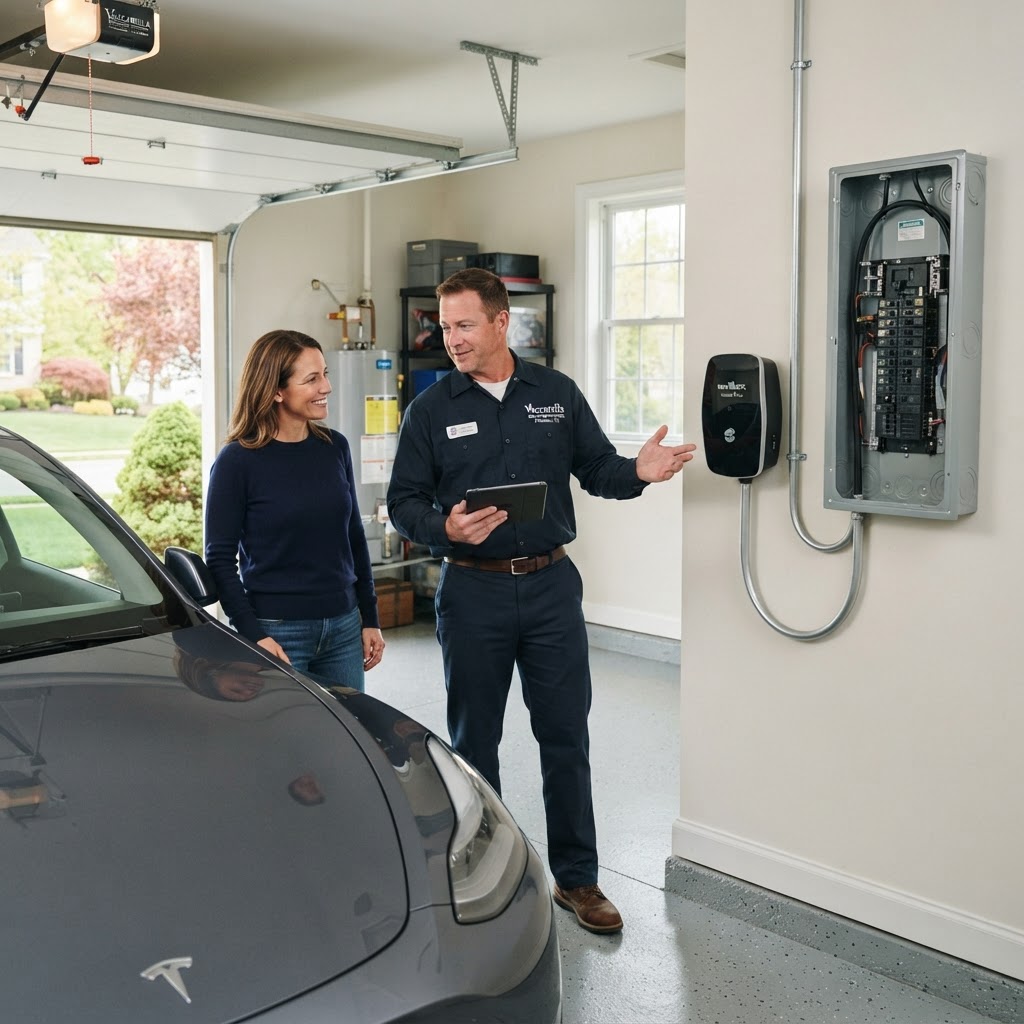
Before installing a charger, Vaccarella Electrical Services evaluates your existing service. In older housing stock found in towns like Ridgewood or Teaneck, many homes still operate on 100-amp panels. A standard Level 2 charger often requires a dedicated 40-amp or 50-amp circuit. If your panel is already nearing its limit due to HVAC systems, electric stoves, and clothes dryers, adding an EV charger might overload the system.
The Role of Load Calculations
An electrical load calculation determines the total demand of your home. If the math shows that your main breaker cannot handle the additional load, you have two primary options: upgrading your electrical service (e.g., from 100-amp to 200-amp) or installing a smart load-management device. These devices automatically throttle the charger's power output when other high-demand appliances in your home are active, potentially preventing the need for a costly panel replacement.
EV Charging in Bergen County: Local Considerations
Northern New Jersey residents face unique challenges. From the historic homes in Englewood to the modern renovations in Franklin Lakes, electrical systems vary wildly in age and condition. Furthermore, local permitting authorities in towns like Paramus or Mahwah have specific requirements for EV installations. Vaccarella Electrical Services (NJ License #16628) works with local inspectors to ensure every installation meets safety standards and municipal codes.
When a Panel Upgrade Is Necessary
Sometimes, a panel upgrade is the safest and most efficient path forward. If your existing panel shows signs of corrosion, uses obsolete fuses, or lacks the physical space for new circuit breakers, we highly recommend an upgrade to 200-amp service. This not only accommodates your new EV but also "future-proofs" your home for other smart-home technologies and climate control systems.
Why Choose Vaccarella Electrical Services?
As a local contractor serving Bergen County, we understand the specific electrical needs of our neighbors. We are fully licensed, bonded, and insured. Don't risk your home's safety with amateur installations. Contact us today for a free quote on your EV charger installation.
Frequently Asked Questions
- Q: Do I need a permit for an EV charger? A: Yes, most municipalities in Northern New Jersey require electrical permits for fixed-wire EV charger installations.
- Q: Is Level 2 charging worth it? A: Yes, it is significantly faster than standard 120V Level 1 charging, perfect for daily commuters.
- Q: How long does a service upgrade take? A: Usually one business day, depending on utility coordination.
- Q: Can I install a charger outdoors? A: Yes, provided the equipment is rated for exterior use (NEMA 3R or higher).
- Q: Does the size of my home affect charging? A: Yes, larger homes with more appliances have higher base loads, affecting available panel capacity.
- Q: Will my electricity bill increase significantly? A: Your usage will increase, but many homeowners find it cheaper than public charging or gasoline.
- Q: Can you work on older homes? A: Yes, we specialize in safely integrating modern tech into historic Northern NJ homes.
Glossary of Terms
- Level 2 Charging: 240-volt charging that provides faster energy transfer than a standard wall outlet.
- Dedicated Circuit: An electrical line reserved exclusively for a single appliance.
- Load Calculation: A mathematical assessment of how much electricity a home uses.
- Service Upgrade: Increasing a home's electrical capacity, often from 100-amp to 200-amp.
- Breaker Panel: The main hub for your home's electrical circuits.
- Amperage (Amps): The measure of electrical current flow.
- Future-Proofing: Installing systems today to handle future electrical demands.
- National Electrical Code (NEC): The benchmark for safe electrical design and installation.