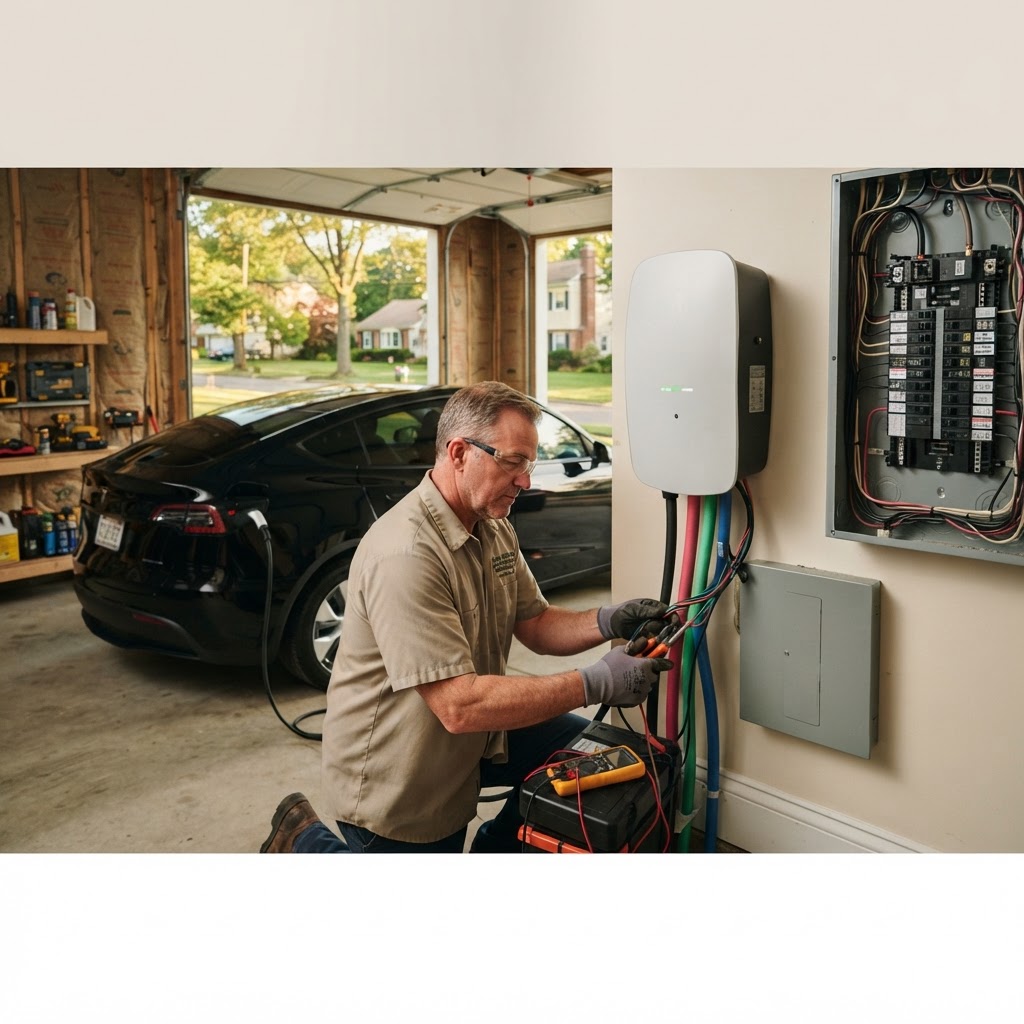
Choosing the right EV charger amperage is critical for Northern New Jersey homeowners. Learn how to balance charging speed with your home's electrical capacity.
Should You Install a 40-Amp, 48-Amp, or 60-Amp EV Charger?
Choosing the right EV charger amperage for your Northern New Jersey home depends on your specific vehicle, your daily driving habits, and the current electrical capacity of your home. As licensed electricians serving Bergen County, the team at Vaccarella Electrical Services frequently helps homeowners navigate these technical decisions to ensure safe, efficient charging.
The Short Answer: How Much Power Do You Need?
For most households in communities like Paramus, Ridgewood, and Franklin Lakes, a 40-amp or 48-amp charger is the standard. A 40-amp charger delivers 9.6 kW, while a 48-amp charger provides 11.5 kW. A 60-amp circuit is often the "gold standard" for future-proofing, as it supports a 48-amp charger at the continuous load limit defined by the National Electrical Code (NEC).
Understanding Amperage and Charging Speed
The speed at which your EV charges is determined by the onboard charger in your vehicle and the amperage of your wall-mounted unit. Because EV chargers are considered "continuous loads," the NEC requires that circuits be rated for 125% of the charger's output. This is why a 48-amp charger requires a 60-amp dedicated circuit breaker.
The 40-Amp Charger
Ideal for plug-in hybrid electric vehicles (PHEVs) or smaller battery EVs. It offers a balance between installation cost and charging speed, often requiring a smaller gauge wire, which can save on installation labor.
The 48-Amp Charger
The most common recommendation for modern all-electric vehicles (EVs). It provides a robust charge overnight, ensuring you wake up to a full "tank" every morning for your commute into NYC or across Bergen County.
The 60-Amp Charger (Hardwired)
While many chargers are capped at 48 amps, installing a 60-amp circuit prepares your home for higher-output hardware. If you anticipate adding a second EV or a heavy-duty truck in the future, this is a smart investment.
EV Charging Considerations for Bergen County Homes
Northern New Jersey features a unique mix of historic housing stock and modern construction. In older homes throughout Teaneck, Englewood, or Hackensack, your existing 100-amp electrical service may not support a high-amperage charger without a service panel upgrade. Before installing an EV charger, we perform a mandatory load calculation to ensure your home's system can handle the additional demand alongside your central air, kitchen appliances, and lighting.
Professional Installation and Permitting
Electrical safety is paramount. Vaccarella Electrical Services (NJ License #16628) ensures every installation follows local codes and manufacturer specifications. Whether you live in Mahwah or Fairlawn, we handle the technical details—from sizing the conductors correctly to ensuring your permit applications are processed accurately.
Why Choose Vaccarella Electrical Services?
We are a locally owned, bonded, and insured contractor serving the Northern New Jersey area. If you are unsure which amperage is right for your home, contact us today for a consultation. Let us evaluate your panel capacity and provide a free quote for your EV charger installation.
Frequently Asked Questions
- Can I charge my car on a standard 120V outlet? Yes, but it is very slow. A Level 2 charger is recommended for daily driving.
- Do I need a 200-amp panel for an EV charger? Not always, but it is often necessary if you have a 100-amp service with limited capacity.
- What is a dedicated circuit? A circuit that powers only the EV charger, preventing tripped breakers.
- How long does installation take? Usually one day, depending on panel capacity and distance from the panel to the garage.
- Can I install the charger myself? No. Local code requires a licensed electrician for safety and permitting.
- What if I move? Hardwired chargers can often be uninstalled and moved to your new home.
- Does weather affect charging? Extreme NJ winters can slow charging speeds slightly, but it shouldn't impact hardware performance.
Glossary of Terms
Amperage (Amps): The strength of an electrical current. Level 2 Charging: 240V charging, much faster than a standard wall outlet. Dedicated Circuit: A circuit restricted to one high-demand appliance. Load Calculation: A method to determine if your electrical panel can support new equipment. NEC: National Electrical Code, the standard for safe electrical work. Continuous Load: Equipment that runs for three or more hours at a time. Hardwired: A direct connection without a plug. Service Panel Upgrade: Increasing your home's total electrical capacity.